Quick Answer Box
The best single sign-on solution for small business in 2026 is Okta Workforce Identity Cloud due to its strong security controls, ease of deployment, excellent app integrations, and scalable pricing for SMBs in the USA and UK. However, Microsoft Entra ID, JumpCloud, and OneLogin are also excellent choices depending on budget, Microsoft ecosystem usage, and compliance requirements.
Introduction
Managing employee passwords across dozens of cloud applications has become a major cybersecurity challenge for small businesses in 2026. From Microsoft 365 and Slack to Salesforce, QuickBooks, Zoom, and Google Workspace, modern SMBs rely on multiple SaaS platforms daily. Unfortunately, every additional login creates another attack surface for cybercriminals.
According to IBM Security’s Cost of a Data Breach Report, compromised credentials remain one of the leading causes of business breaches worldwide. Meanwhile, Cybersecurity Ventures estimates that cybercrime damages will exceed $10.5 trillion annually, making identity protection a top priority for businesses in both the USA and UK.
This is where Single Sign-On (SSO) solutions become essential.
A reliable SSO platform allows employees to securely access multiple applications with one login while giving IT teams centralized identity management, access control, compliance reporting, and stronger security enforcement through MFA and Zero Trust principles.
In this guide, LifeSure Security compares the best single sign-on solutions for small business in 2026, including pricing, security features, compliance support, scalability, ease of use, and real-world SMB deployment considerations.
What Is a Single Sign-On (SSO) Solution?
Single Sign-On (SSO) is an identity and access management (IAM) technology that allows users to log in once and securely access multiple business applications without repeatedly entering passwords.
Instead of managing separate credentials for every platform, employees authenticate through a centralized identity provider.
How SSO Works
An SSO provider authenticates users through standards such as:
- SAML 2.0
- OAuth 2.0
- OpenID Connect (OIDC)
- LDAP
- Active Directory Integration
Once authenticated, users gain secure access to connected applications.
Example
A UK accounting firm using:
- Microsoft 365
- Xero
- Slack
- Zoom
- Salesforce
can allow employees to access all systems using one secure login protected by MFA.
Why Small Businesses Need SSO in 2026
Rising Credential-Based Attacks
The U.S. Cybersecurity and Infrastructure Security Agency (CISA) reports that password-related attacks remain one of the most common intrusion methods targeting SMBs.
Common threats include:
- Phishing
- Credential stuffing
- Password reuse attacks
- Session hijacking
- Insider threats
Key Benefits of SSO for SMBs
| Benefit | Business Impact |
|---|---|
| Reduced Password Fatigue | Employees use fewer passwords |
| Improved Security | Centralized authentication and MFA |
| Faster Employee Onboarding | Instant access provisioning |
| Easier Compliance | Better audit logs and reporting |
| Lower IT Costs | Reduced password reset tickets |
| Better User Experience | Faster workflow access |
Best Single Sign-On Solutions for Small Business in 2026
Feature Comparison Table
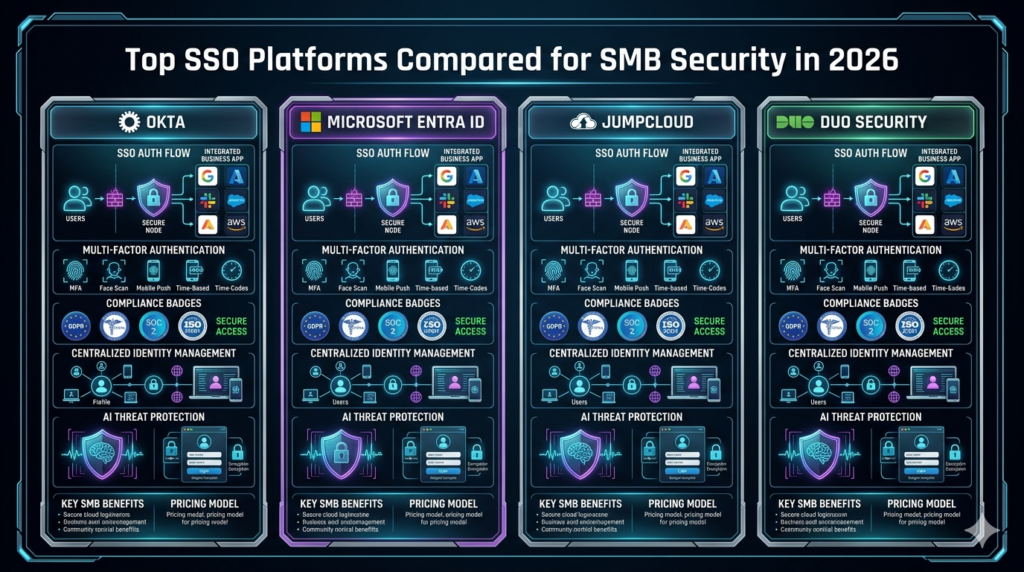
| Software | Best For | MFA Included | Compliance Support | Starting Price | Rating |
|---|---|---|---|---|---|
| Okta | Growing SMBs | Yes | SOC 2, HIPAA, GDPR | $6/user/month | 4.9/5 |
| Microsoft Entra ID | Microsoft environments | Yes | ISO 27001, GDPR | $6/user/month | 4.8/5 |
| JumpCloud | Hybrid SMB IT | Yes | SOC 2, HIPAA | $11/user/month | 4.7/5 |
| OneLogin | Budget-conscious SMBs | Yes | SOC 2, GDPR | Custom pricing | 4.6/5 |
| Duo Security | MFA-first businesses | Yes | HIPAA, PCI DSS | $3/user/month | 4.5/5 |
| Ping Identity | Mid-market compliance | Yes | NIST, GDPR | Custom pricing | 4.6/5 |
1. Okta Workforce Identity Cloud
Why Okta Is the Best Overall SSO Solution
Okta remains the market leader for SMB identity security because of its reliability, massive app integration library, and advanced Zero Trust security controls.
With more than 7,000 pre-built integrations, Okta simplifies access management for growing businesses.
Key Features
- Universal Directory
- Adaptive MFA
- Lifecycle Management
- Device Trust Policies
- API Access Management
- ThreatInsight risk detection
- Real-time user provisioning
Best For
- SMBs with remote teams
- SaaS-heavy businesses
- Healthcare and finance companies
- UK GDPR-sensitive organizations
Pros
- Extremely easy deployment
- Excellent UI and admin dashboard
- Strong compliance support
- Large integration ecosystem
- Scales easily
Cons
- Advanced features cost extra
- Can become expensive at scale
Expert Tip
Small businesses planning rapid growth should prioritize SSO vendors with strong lifecycle automation. Automated onboarding and offboarding significantly reduce insider risk exposure.
2. Microsoft Entra ID (Formerly Azure AD)
Best SSO for Microsoft 365 Businesses
If your business already relies on Microsoft 365, Teams, SharePoint, or Windows devices, Microsoft Entra ID delivers excellent value.
Its native ecosystem integration is unmatched for Microsoft-first companies.
Key Features
- Conditional Access Policies
- Passwordless Authentication
- Identity Protection
- Self-service password reset
- Hybrid Active Directory support
- Risk-based authentication
Best For
- Microsoft-centric SMBs
- Hybrid workforces
- Businesses using Windows infrastructure
Pros
- Strong Microsoft integration
- Competitive pricing
- Enterprise-grade security
- Excellent compliance coverage
Cons
- Complex setup for beginners
- Interface may overwhelm smaller IT teams
3. JumpCloud
Best SSO Solution for Hybrid IT Environments
JumpCloud has become extremely popular among SMBs that manage mixed environments across Windows, Linux, and macOS systems.
It combines:
- Device management
- Directory services
- SSO
- MFA
- Endpoint controls
into a unified cloud platform.
Key Features
- Cross-platform device management
- Cloud LDAP
- Zero Trust controls
- Conditional access
- Remote device policies
- Password manager integration
Pros
- Excellent for remote teams
- Strong cross-platform support
- Combines IAM and endpoint management
- Simplifies IT administration
Cons
- Learning curve for advanced policies
- Smaller integration catalog than Okta
4. OneLogin
Best Budget-Friendly SSO Platform
OneLogin offers strong security capabilities without enterprise-level pricing.
It is particularly attractive for startups and smaller SMBs with limited IT staff.
Key Features
- SmartFactor Authentication
- Unified Access Management
- Secure single-click access
- Policy-based authentication
- User provisioning
Pros
- Affordable
- User-friendly interface
- Good MFA options
- Fast deployment
Cons
- Fewer advanced analytics features
- Smaller partner ecosystem
5. Duo Security
Best MFA-Focused SSO Platform
Owned by Cisco, Duo Security focuses heavily on multi-factor authentication and secure access verification.
While not as feature-rich as Okta, it offers excellent security for smaller organizations.
Key Features
- Push authentication
- Device health checks
- VPN integration
- Risk-based access
- Passwordless login
Pros
- Very affordable
- Excellent MFA security
- Easy deployment
- Strong mobile support
Cons
- Limited advanced IAM capabilities
- Smaller SSO integration library
Pricing Comparison Table
| Vendor | Entry Pricing | Free Trial | Best Business Size |
|---|---|---|---|
| Okta | $6/user/month | Yes | SMB to Enterprise |
| Microsoft Entra ID | $6/user/month | Yes | SMB and Mid-Market |
| JumpCloud | $11/user/month | Yes | Hybrid SMB |
| OneLogin | Custom | Yes | SMB |
| Duo Security | $3/user/month | Yes | Small SMB |
| Ping Identity | Custom | Demo only | Mid-Market |
Which SSO Solution Is Best for Compliance?
Best Compliance-Focused Vendors
| Compliance Standard | Recommended Vendor |
|---|---|
| HIPAA | Okta |
| SOC 2 | JumpCloud |
| GDPR | Microsoft Entra ID |
| ISO 27001 | Okta |
| PCI DSS | Duo Security |
| NIST Alignment | Ping Identity |
Businesses in regulated industries such as healthcare, finance, and legal services should prioritize vendors with strong audit logging, policy enforcement, and identity governance features.
How to Choose the Best Single Sign-On Solution
1. Evaluate Application Compatibility
Check whether your business apps support:
- SAML
- OAuth
- OIDC
- SCIM provisioning
The best SSO solutions provide prebuilt integrations.
2. Prioritize MFA and Zero Trust
Modern identity security requires:
- MFA
- Device trust
- Behavioral analytics
- Adaptive authentication
SSO without MFA is no longer sufficient in 2026.
3. Consider Compliance Requirements
USA businesses may require:
- HIPAA
- SOC 2
- CCPA
UK businesses often prioritize:
- GDPR
- ISO 27001
- Cyber Essentials
4. Analyze Total Cost
Some vendors charge extra for:
- Lifecycle automation
- API access
- Compliance reporting
- Advanced MFA
Always calculate full deployment cost.
Pro Tip
Businesses with fewer than 100 employees often overspend on enterprise IAM platforms. Start with scalable SMB-friendly licensing before upgrading to enterprise tiers.
Real-World SMB Example
A 75-employee law firm in London deployed Microsoft Entra ID with MFA across:
- Microsoft 365
- Clio
- Zoom
- Salesforce
Results after deployment:
- 70% reduction in password reset tickets
- Faster onboarding for remote employees
- Improved GDPR audit reporting
- Reduced phishing-related incidents
This demonstrates how even smaller firms can significantly improve security and operational efficiency using SSO.
Also read Okta vs Microsoft Azure AD: Which IAM Wins 2026.
Common SSO Mistakes Small Businesses Make
1. Ignoring MFA
SSO alone is not enough.
Always enable:
- MFA
- Conditional access
- Device verification
2. Overcomplicated Policies
Complex access rules create user frustration and shadow IT.
Keep policies simple initially.
3. Forgetting Offboarding Automation
Former employees retaining SaaS access remains a major insider threat risk.
Automated deprovisioning is critical.
Frequently Asked Questions (FAQ)
What is the best single sign-on solution for small business?
Okta is currently the best overall SSO solution for small businesses due to its strong security, ease of use, scalability, and extensive integrations.
Is SSO worth it for small businesses?
Yes. SSO improves security, reduces password fatigue, lowers IT support costs, and helps businesses meet compliance requirements.
What is the difference between SSO and MFA?
SSO allows one login for multiple applications, while MFA adds additional identity verification layers such as mobile authentication or biometrics.
Can small businesses afford SSO solutions?
Yes. Many modern SSO vendors offer affordable SMB pricing starting around $3 to $6 per user monthly.
Which SSO solution is best for Microsoft 365?
Microsoft Entra ID is the best option for businesses heavily invested in Microsoft ecosystems.
Does SSO improve cybersecurity?
Yes. SSO reduces password reuse, centralizes authentication, improves visibility, and strengthens access control policies.
Is Google Workspace SSO enough for SMBs?
For very small businesses, Google Workspace SSO may work initially. However, growing organizations typically need advanced IAM controls, compliance reporting, and lifecycle management.
Final Verdict: Which SSO Platform Wins in 2026?
Winner: Okta Workforce Identity Cloud
After comparing security, scalability, integrations, compliance support, pricing, and SMB usability, Okta remains the best single sign-on solution for small business in 2026.
Why Okta Wins
- Best balance of security and usability
- Massive integration ecosystem
- Excellent MFA and Zero Trust features
- Strong compliance support
- Ideal for USA and UK SMB growth
Best Alternatives
- Microsoft Entra ID — Best for Microsoft-centric organizations
- JumpCloud — Best for hybrid IT environments
- Duo Security — Best budget-friendly MFA-first solution
Conclusion
Choosing the best single sign-on solution for small business is no longer optional in 2026. Identity-based attacks continue rising, compliance regulations are becoming stricter, and hybrid workforces require secure access management across multiple platforms.
For most SMBs, implementing a modern SSO platform with MFA dramatically improves both cybersecurity and operational efficiency.
Businesses should focus on:
- Strong MFA support
- Compliance capabilities
- Easy onboarding/offboarding
- Scalable pricing
- Reliable app integrations
If your organization handles sensitive customer data, financial records, healthcare information, or legal documentation, investing in enterprise-grade identity security is one of the smartest cybersecurity decisions you can make.
Visit LifeSure Security for more in-depth cybersecurity software reviews, IAM buying guides, endpoint security comparisons, and expert business cybersecurity insights.
Disclaimer
Pricing, features, and vendor offerings may change over time. Businesses should verify current pricing and compliance capabilities directly from official vendor websites before making purchasing decisions. This article is for informational and educational purposes only and does not constitute legal, compliance, or cybersecurity consulting advice.